Understanding the Limits of Generative AI in Business Workflows
What Generative AI Can and Cannot Do for Your Business
Generative AI has captured the imagination of professionals across industries. From drafting emails to generating code snippets, these tools can produce text, images, and even music that resemble human output. But as businesses rush to integrate generative AI into everyday processes, it's essential to step back and examine where the technology falls short. Understanding these limitations is not about dismissing the tool but about using it wisely. For professionals taking a course on building generative AI applications, such as the one offered by UCC, grasping these boundaries is part of responsible AI training.
Generative AI models, like large language models, are trained on vast datasets. They learn patterns, structures, and associations from the text and images they are fed. When given a prompt, they predict the most likely next word or pixel. This makes them excellent at producing plausible-sounding content. But plausible does not mean accurate, and fluency does not equal truth. The core limitation is that these models have no understanding of the real world. They do not possess knowledge, beliefs, or intentions. They simply generate content that looks like what they have seen before. This can lead to outputs that are factually incorrect, inconsistent, or outright nonsensical.
The Problem of Hallucination and Factual Accuracy
One of the most cited limitations of generative AI is hallucination. The model confidently presents information that is false. For a business process that relies on accurate data, this can be catastrophic. Imagine using a generative AI tool to draft a compliance report or a customer-facing FAQ. If the AI invents a regulation or misstates a policy, the consequences could be legal or reputational. This is why human oversight is not optional. Every piece of content generated by AI must be reviewed by a person who understands the subject matter. This adds a layer of cost and time that some businesses underestimate.
Moreover, generative AI models have a limited context window. They can only consider a fixed amount of recent text when generating a response. This means they can lose track of earlier parts of a long conversation or document. In a business setting, this can lead to inconsistencies. For example, a model might start a report with one set of assumptions and later contradict them because it has forgotten the earlier context. This is particularly problematic when the AI is used to process multiple pieces of information in sequence, such as in a customer support chat that spans several turns.
Bias and Data Privacy Concerns
Generative AI models learn from the data they are trained on. If that data contains biases, the model will reproduce and sometimes amplify them. This can lead to outputs that are unfair or discriminatory. For a business, this is a serious risk. For instance, an AI used in hiring might produce job descriptions that inadvertently favour certain demographics. Or a marketing AI might generate content that stereotypes groups of people. Bias is not a bug that can be fixed overnight. It requires ongoing monitoring, careful selection of training data, and sometimes retraining of models. This is a core part of responsible AI training.
Data privacy is another major concern. Many generative AI tools are cloud-based, meaning that the data you feed into them is sent to external servers. If that data includes sensitive information such as customer names, financial details, or internal strategies, you could be violating privacy regulations. Access control becomes a critical issue. Businesses must decide what data can be safely shared with an external AI service and what must remain on-premises. This often requires implementing strict data governance policies and using models that can be deployed locally, at least for the most sensitive tasks.
Output Monitoring and Risk Assessment
Because generative AI outputs can be unpredictable, businesses need robust output monitoring. This means having systems in place to check the AI's work for errors, biases, or inappropriate content. It also means performing a risk assessment before deploying the AI in any critical process. For example, a generative AI tool used to generate internal training materials carries a different risk profile than one used to generate customer-facing content. The level of human oversight should match the risk. High-risk applications might require multiple levels of review, while low-risk ones might only need a quick scan.
A common mistake is to treat generative AI as a set-and-forget solution. But these models require ongoing tuning and retraining. The world changes, and the data the model was trained on can become outdated. A model that was accurate six months ago might now give poor results. This means businesses must invest in continuous evaluation and, when necessary, retrain the model with new data. This is not a one-time cost but a recurring one. Professionals who take a course like the one at UCC learn about these maintenance requirements as part of building a responsible AI system.

The Need for Human Judgment
Generative AI can be a powerful assistant, but it cannot replace human judgment. It cannot understand context the way a person does. It cannot read between the lines or grasp the tacit knowledge that comes from experience. For tasks that require empathy, creativity, or ethical reasoning, AI is still far behind. A generative AI tool might draft a polite email, but it cannot truly understand the emotional state of the recipient. It can generate a list of ideas for a brainstorming session, but it cannot evaluate which ones are feasible or valuable. This is why the most effective use of generative AI is as a co-pilot, not an autopilot.
Another limitation is the cost of computation. Training and running large generative AI models requires significant computing power. This translates into energy consumption and financial cost. For small and medium businesses, the expense can be prohibitive. Even using a cloud-based API adds up, especially if the business needs to process large volumes of data. This economic constraint means that businesses must be strategic about when and how they use generative AI. Not every problem needs an AI solution. Sometimes a simple rule-based system or a human is more efficient and cost-effective.
Practical Steps for Responsible AI Training
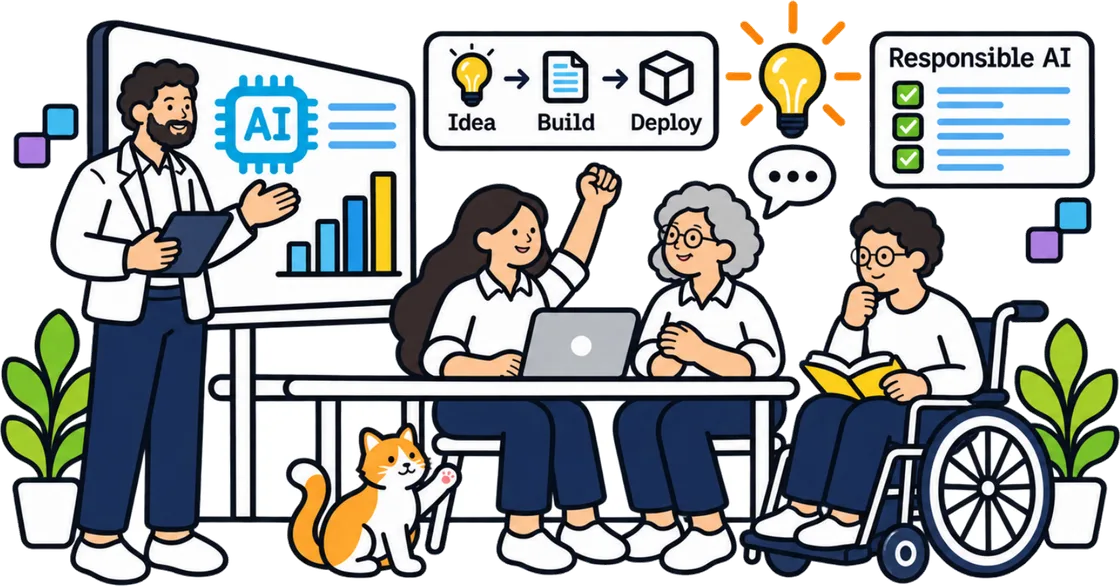
Given these limitations, what should a business do? The answer lies in responsible AI training. This means educating everyone involved in the design, deployment, and use of AI systems about the risks and best practices. It involves establishing clear guidelines for when AI can be used and what checks must be in place. It also means fostering a culture of critical thinking where employees feel empowered to question the AI's output. For professionals attending a course like the one at UCC, these principles are woven into the curriculum. They learn not just how to build a generative AI application, but also how to audit its outputs and mitigate its weaknesses.
In practice, this looks like creating a checklist before deploying any generative AI tool. First, define the task clearly. Is this a task that AI can do well, or would a human be better? Second, assess the data. Is the data sensitive? Will the model have access to private information? Third, plan for oversight. Who will review the AI's output? How often? Fourth, set up monitoring. What metrics will you track to detect errors or drift? Fifth, have a rollback plan. If the AI starts producing bad results, how will you disconnect it quickly? These steps are part of a broader risk assessment and access control strategy that every organisation should have.
Generative AI is a tool, not a replacement for human expertise. Its main limitations - hallucination, bias, lack of understanding, data privacy issues, and the need for human oversight - are not reasons to avoid it. They are reasons to approach it with caution and respect. By investing in responsible AI training, businesses can harness the benefits of generative AI while minimising the risks. For professionals in Singapore looking to build practical skills, a focused course that covers both the technical and ethical aspects of generative AI provides a solid foundation. Understanding what the technology cannot do is just as important as understanding what it can.